
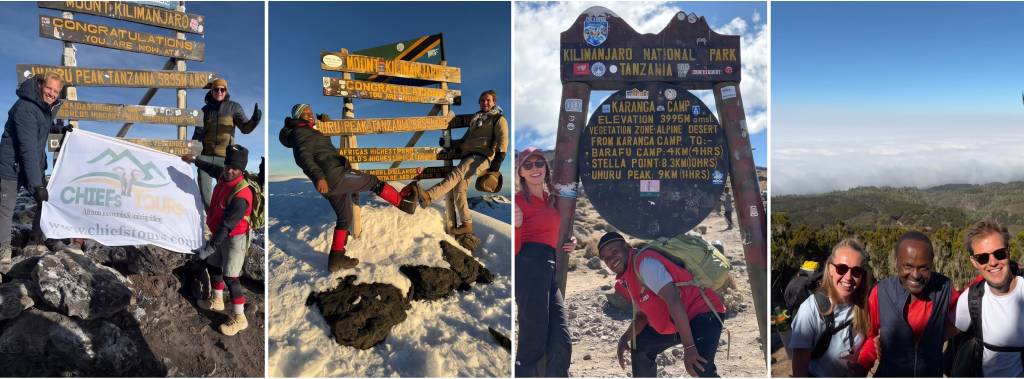
There is something different about summit night on Kilimanjaro from what the usual trek. In this article, we talk about the cold, darkness, slow pace, altitude and final climb to Uhuru Peak.
During the day, you can see the trail ahead of you. You can see the forests, valleys, rocks, and other climbers around you. You can stop at a viewpoint and look back at how far you have come.
Summit night is different.
You leave camp when most people are asleep. Your headlamp becomes your main source of light. The temperature drops. The trail becomes steeper. Your pace becomes slower. With every step, the mountain demands more from you.
And for several hours, your world becomes very simple: Put one foot in front of the other, rest when your guide tells you to. Keep warm. Breathe. Keep moving.
Eventually, the darkness begins to disappear, and the sky starts changing colour.
Then you realise that you are getting close to the roof of Africa.
Kilimanjaro rises to 5,895 metres above sea level, and the final ascent is one of the most demanding parts of the climb. Altitude is a major factor, which is why your Kilimanjaro route, number of days and acclimatization schedule matter long before summit night begins.
So what does summit night on Kilimanjaro really feel like?
Here is what you should expect.
Summit Night Is Different From Every Other Day on Kilimanjaro
By the time the summit night arrives, you have already spent several days walking across the mountain.
You have climbed through the rainforest. You have walked across moorland. You have crossed high altitude desert. You have watched the landscape change as you gained elevation.
You have probably already had moments when you wondered whether you were really going to make it.
But summit night is different because you are now approaching the highest part of the mountain.
Most summit attempts begin around midnight or in the early hours of the morning, although the exact departure time depends on the route, camp, and your head guide’s climbing plan.
Why you star the summit attempt at that time is because we want to reach the crater rim and continue toward Uhuru Peak around sunrise or during the morning.
That means you will be climbing while most people are sleeping.
What Happens Before You Leave Camp?
You usually do not simply wake up and walk out of camp. Your guide will have already explained the plan.
You will have your warmest clothing ready. Your headlamp needs to be working. Your water needs to be accessible. Your gloves, hat, and other essential items need to be where you can reach them.
You may have something to eat and drink before leaving.
Then comes the moment when you step outside.
It can feel strangely quiet.
Your fellow climbers are preparing around you, guides and porters are moving around camp, and somewhere above you is the mountain you have spent days climbing toward.
Then the group starts walking.
Then You Step Into the Darkness
The first thing many climbers notice is how little they can actually see. Your headlamp shows you a small section of the trail in front of you. Beyond that, there may be almost complete darkness.
You cannot see the entire mountain. You cannot see how far the next section goes.
You cannot look up and say, “I only have this much farther to go.”
In some ways, this can make the climb easier mentally. You concentrate on the few metres in front of you. One step. Then another. Then another.
Your guide may keep reminding you to walk slowly.
This is where the famous Kilimanjaro phrase “pole pole”, meaning slowly slowly, becomes very real.
Why Does the Pace Become So Slow?
On summit night, walking quickly is usually not the goal.
You are climbing at very high altitude, where the available oxygen is significantly lower than at sea level. Your body is already working harder, and the steep terrain adds another challenge. The rate at which you gain altitude and the amount of time you have allowed your body to acclimatize are important factors in altitude illness.
So your guide may set a pace that initially feels almost frustratingly slow.
You may think:
“Why are we walking this slowly?”
The answer is that summit night is not a race.
A controlled pace allows you to conserve energy and gives your guide a better opportunity to observe how you are coping with the altitude and effort.
This is one reason experienced mountain guides matter. They are not simply showing you the trail. They are managing the climb with you.
The Cold Becomes Part of the Challenge
The temperature can fall significantly as you climb higher, and the combination of cold, darkness, wind, and altitude can make summit night feel very different from the lower sections of the mountain.
Your clothing becomes important.
Warm layers. A good hat. Gloves. Proper socks. Suitable footwear.
And clothing that allows you to adjust as conditions change.
You may start walking feeling reasonably comfortable, but after hours outside in the darkness, the cold becomes something you have to actively manage.
This is why your guide and preparation team will normally want you properly equipped before leaving camp.
What Does the Trail Feel Like During the Summit Attempt?
There is no single description that fits every route.
The exact experience depends on where you are climbing from, the weather conditions, and your itinerary.
But as you approach the summit, the terrain becomes more demanding.
You are climbing at high altitude, and your body does not respond to exertion in quite the same way it does at lower elevations.
A short section of trail can feel much longer than you expected. A few steps can require concentration.
You may take several steps and then pause. You may find yourself looking at the ground more than the scenery.
And because it is dark, you often cannot see the entire climb ahead of you.
This is another reason experienced guides keep the group moving at a controlled pace.
The Mental Challenge Can Be Bigger Than You Expect
Summit night is physical, but it is also mental.
At some point, you may start thinking:
“How much longer?” Then: “Can I really do this?” Then: “Maybe I should stop.”
This is normal.
You have been awake during the night. You are cold. You are tired. You are climbing at high altitude. The summit can still feel far away.
A good guide understands this.
Instead of allowing you to become overwhelmed by the entire climb, the focus becomes the next step.
Then the next one. Then the next.
This is where the philosophy of “inch by inch is a cinch, yard by yard is hard” makes sense.
Do not spend all your energy thinking about the top. Deal with what is directly in front of you.
What Your Guide Is Watching During the Summit Attempt
Your guide has an important role during summit night.
They are watching more than your walking speed.
They are paying attention to how you are moving, communicating and responding to the climb. They are also watching the weather, trail conditions and the overall situation within the group.
Most importantly, climbers should communicate honestly about how they feel.
Do not hide a headache, nausea, unusual weakness, dizziness or other symptoms because you are afraid of disappointing your group.
Altitude illness can affect people regardless of their fitness level, and physical fitness does not eliminate the risk.
A summit is never more important than your safety.
Stella Point: A Major Moment
Eventually, after hours of climbing, you may reach Stella Point on the crater rim.
For many climbers, this is an emotional moment. You have spent hours climbing through darkness.
Then suddenly the environment changes. You are at the crater rim.
You may begin to see the first light of morning. But there is an important distinction. Stella Point is not Uhuru Peak. It is one of the points on the crater rim.
From Stella Point, you still have a section of trail to walk before reaching Uhuru Peak, the highest point of Mount Kilimanjaro.
For someone who has already spent hours climbing, that final section can feel surprisingly difficult.
But now you have something you did not have earlier.
Daylight.
And you can see where you are going.
Then the Sun Comes Up
This is one of the moments people remember most. The darkness slowly gives way to light.
The sky begins to change. The surrounding landscape becomes visible.
The mountain that looked completely different in the dark now appears in front of you.
And for a few minutes, the cold and exhaustion may not seem quite as important.
You realise that you have climbed through the night.
You have made it this far.
And Uhuru Peak is close.
The Final Walk to Uhuru Peak
From the crater rim, you continue toward Uhuru Peak. The walking may still feel slow. You are tired.
Your legs have already done several hours of work. You are still at extreme altitude.
But psychologically, the situation has changed. The summit is no longer an idea.
You can see it. You know where you are going. Eventually, you reach the summit sign at Uhuru Peak.
At 5,895 metres, you are standing at the highest point of Mount Kilimanjaro and the highest point in Africa. For some climbers, there are tears.
For others, there is laughter. Some people become very quiet. Some immediately start taking photographs. There is no single correct reaction.
After everything that happened during the night, simply being there can be enough.
The Descent Is Not an Afterthought
One mistake climbers sometimes make mentally is treating the summit as the end. It is not.
You still have to descend. And after several hours of climbing, the descent can be physically demanding.
Your legs are tired. Your concentration may not be the same as it was earlier.
The terrain that was difficult to climb can also be challenging to walk down.
This is why summit day should be approached as one complete effort rather than simply a race toward Uhuru Peak.
Your guide will continue to manage the group after the summit.
What Summit Night Really Tests
Summit night tests several things at once.
Your preparation.
Did you bring the right equipment?
Your pacing.
Can you resist the temptation to go too fast?
Your acclimatization.
Has your itinerary given your body enough time to adjust to the increasing altitude?
Your mindset.
Can you keep going when the summit still feels far away?
Your communication.
Will you tell your guide honestly when something does not feel right?
And perhaps most importantly, it tests your patience.
Kilimanjaro rewards people who understand that the mountain cannot be rushed.
What an Experienced Kilimanjaro Guide Knows
At Chiefs Tours, our mountain guides have spent years learning that Kilimanjaro is not simply about reaching the top.
Our Head Guide has more than 26 years of experience on the mountain. He started as a porter in 1994, became a professional mountain guide in 2001 and has climbed Kilimanjaro hundreds of times across the major routes.
His philosophy is simple:
“The mountain does not care about academic degrees or experience on other mountains. You need someone who knows and understands this mountain.”
That experience becomes particularly valuable on summit night.
A guide who knows the mountain understands that every climber is different.
Some people are strong physically but struggle with altitude.
Others start slowly and become stronger as the night continues.
Some need encouragement. Others need quiet. Some need to adjust their pace.
The job is not simply to shout “keep going.”
It is to understand what is happening and make sensible decisions throughout the climb.
How to Prepare for Summit Night
You do not prepare for summit night only on summit night. Preparation begins when you choose your route and itinerary.
Choose enough days
Shorter climbs can mean a faster increase in sleeping altitude. Longer itineraries can provide more time for acclimatization.
Take your equipment seriously
Your summit clothing should be tested before the climb.
Do not wait until summit night to discover that your gloves are uncomfortable or your headlamp is unreliable.
Walk slowly
You may feel strong during the first part of the climb. Do not let that convince you to race ahead. The mountain is still there several hours later.
Listen to your guide
Your guide has a different perspective from you. You are experiencing the climb from inside your own body. Your guide is watching the wider situation. Work together.
Tell the truth about how you feel
If you have symptoms or feel that something is wrong, speak up.
Altitude illness is unpredictable, and being fit does not make someone immune.
Focus on the next step
Do not spend the entire night thinking about Uhuru Peak. Think about the next section.
The next rest. The next few steps.
Then repeat. That is how summit night is often won.
Frequently Asked Questions
What time do you start summit night on Kilimanjaro?
Most summit attempts begin around midnight or during the early hours of the morning, although the exact departure time depends on the route, camp location, weather and the climbing plan.
How cold is summit night on Kilimanjaro?
Summit night can be extremely cold, particularly near the summit, and conditions vary depending on altitude, wind and weather. This is why proper warm layers, gloves, head covering and suitable footwear are important.
How long does summit night take?
The duration varies between climbers, routes, camps, and conditions. The summit attempt itself can take several hours, followed by the descent. Your guide will set the pace according to the group and the conditions.
Is summit night difficult?
Yes, summit night is usually the most physically and mentally demanding part of a Kilimanjaro climb. You are walking in darkness, dealing with cold, and climbing at a very high altitude. The experience can be made more manageable through appropriate pacing, preparation, and acclimatization.
Why do Kilimanjaro guides walk so slowly?
The slow pace helps conserve energy and allows the group to climb in a controlled way at high altitude. “Pole pole” is an important part of the Kilimanjaro climbing approach.
What happens if I become sick during summit night?
Tell your guide immediately.
Do not try to hide symptoms because you want to reach the summit. Altitude illness can become serious, and continuing to ascend while symptoms are worsening can be dangerous. Depending on the situation, the guide may decide that the climber needs to stop ascending or descend.
Can I reach Uhuru Peak without being extremely fit?
Good physical preparation is important for a demanding mountain climb, but fitness does not eliminate the risk of altitude illness. Your ability to cope with altitude also depends on factors such as your rate of ascent and individual response to high altitude.
Read to Summit Kilimanjaro succesfully?
Though the success is not guaranteed, what we can tell you is that most of our clients reach the summit, (98% success rate). Contact us now to schedule your Kilimanjaro Climb with our experienced guides.